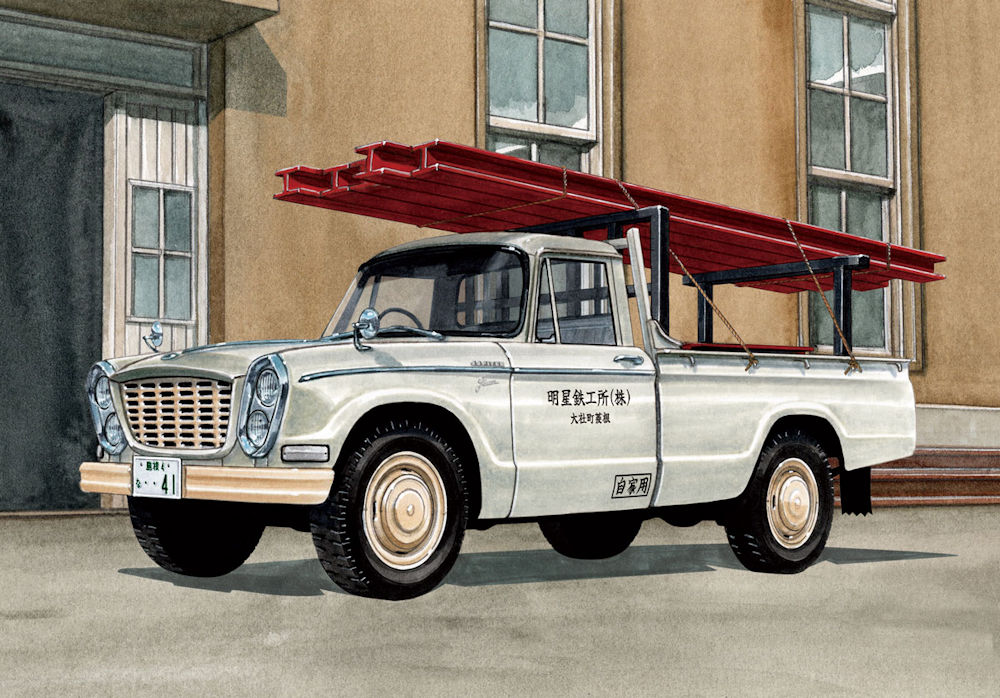
“Jupiter Junior”
In the early 1960s, as Japan’s postwar recovery gave way to rapid economic growth, demand for small trucks surged. Although Toyota and Nissan already dominated that market, Mitsubishi leveraged the technology from its successful Jupiter medium-duty truck to launch the Jupiter Junior in 1963.The distinctive design, incorporating elements seen in American cars of the era such as slanted headlamps and a wraparound windshield, was the work of freelance designer Tokujiro Kaneko.

“Delica Coach”
The Delica Coach (9-seater) was introduced in 1969 as a derivative of the Delica Truck launched in 1968, together with the Light Van and Route Van. It was characterized by its rounded style with curved side window glass, an early feature at the time, and was the first in its class to seat three passengers in the front seats. The two-tone paint scheme with its passenger car feel may have been inspired by the Mazda Bongo, which was already popular at the time.
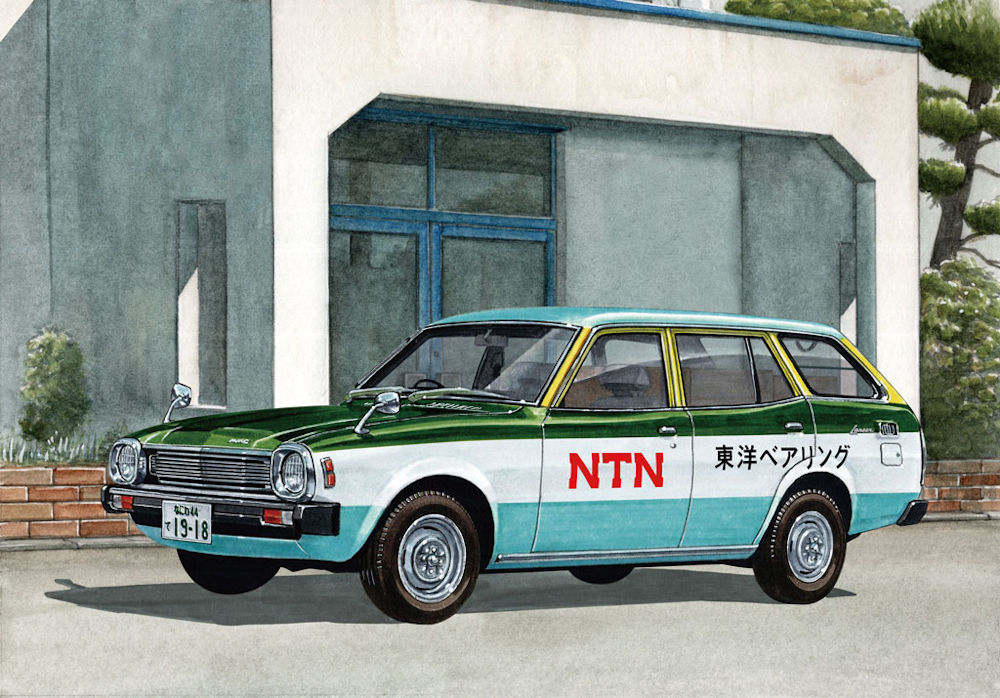
“New Lancer Van”
The New Lancer was a major facelift model released in 1976, 3years after the 1st-gen Lancer debuted, featuring changes to the hood, front grille, front and rear bumpers, rear body (sedans), and tail lamps.While its appearance at first glance differed little from the pre-change model, this update was specifically for its launch in North America as the 3rd-gen Dodge Colt through Chrysler. Sales volume in North America exceeded that in Japan.
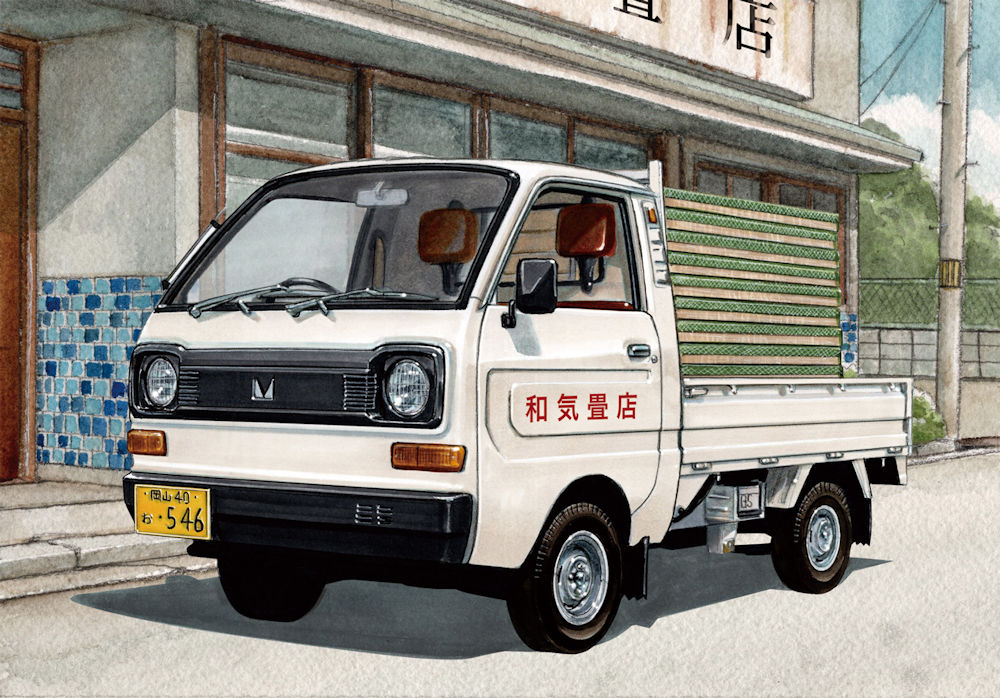
“Minicab Wide 55”
The Minicab Wide 55 was a major facelift of the3rd-gen Minicab that went on sale in 1977, following the revision of the kei-car standards. The overall width was increased by 100 mm to 1395 mm, and the displacement was increased by 50 cc to 550 cc. This revision led to a rapid increase in the overall market for kei cars, which would continue until the bursting of the bubble economy in 1990.
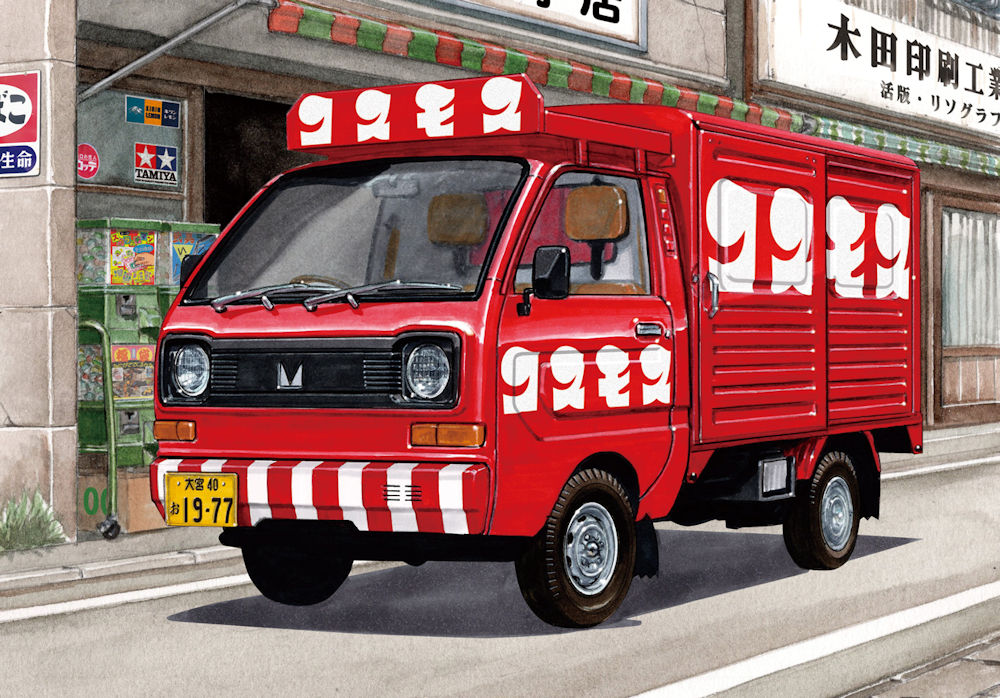
“Mini Cab Wide 55 Cosmos delivery truck”
Cosmos Co., Ltd. was one of the original creators of the manual vending machine known as the “gachagacha.”They provided weekly delivery service via trucks to vending machines placed in stores like candy shops. The background of this illustration depicts such a shop with its “gachagacha” machine nicely rendered.

“Lancer EX 1800 GSR TURBO”
A high-performance model of the Lancer EX combining a 1.8-liter engine with a Mitsubishi Heavy Industries turbocharger. Starting with the 1983 model, an intercooler was added, delivering a maximum output of 160 PS and maximum torque of 22.0 kgf·m. Leveraging its lightweight body, it excelled in domestic rally competitions.

“1st gen Pajero”
The 1st-gen Pajero, which spearheaded Japan’s RV boom and achieved the first overall victory for a Japanese vehicle in the Dakar Rally. As a brand-new 4WD model, sales projections were extremely low. The planned sales volume, scraped together from worldwide markets, was a mere 2,000 units per month—the absolute minimum needed to make the business viable. However, after launch, sales doubled every year, reaching 10,000 units per month within five years. Domestically, it even sparked a phenomenon that defied common sense: users of sports cars and luxury vehicles began switching to the Pajero.

”Starion ”
Developed as the successor to the Lancer Celeste, the Starion was initially conceived as a mild sports coupe. However, a hot-looking design proposal referenced by partner Chrysler triggered a shift in direction. The project was reoriented toward a more sports car-like character, positioning it to compete with the Porsche 924 Turbo. This resulted in the adoption of a hot, aggressive design unlike anything seen before in Mitsubishi cars.
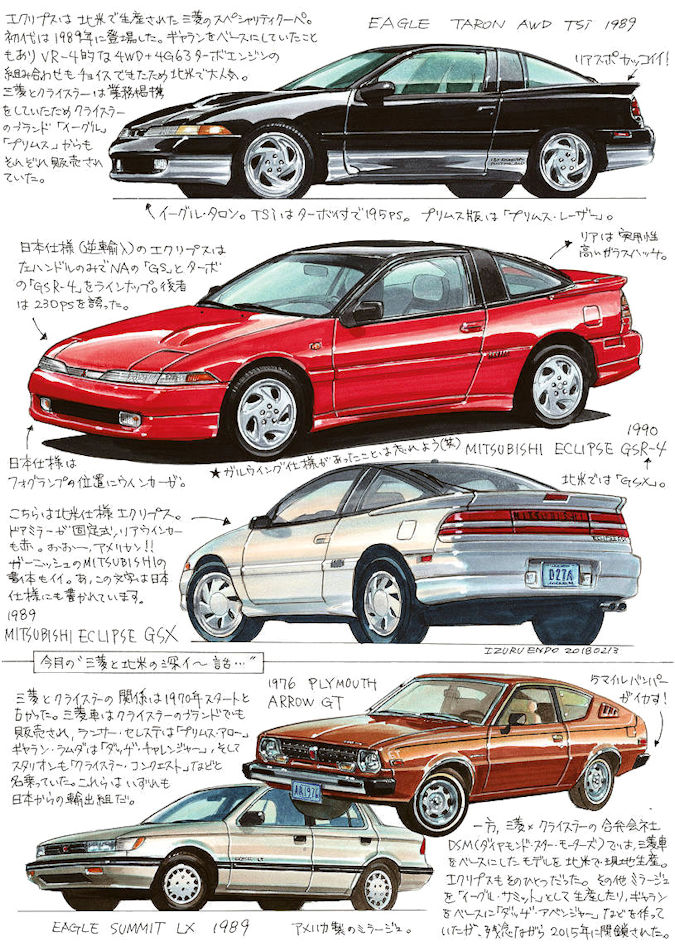
“Mitsubishi cars in North America”
The Mitsubishi Eclipse, a specialty coupe produced in North America, debuted in 1989. Based on the Galant, it offered the popular VR-4 combination of 4WD and the 4G63 turbo engine, making it hugely popular in North America. Due to Mitsubishi’s business alliance with Chrysler, it was also sold under Chrysler’s Eagle and Plymouth brands. The relationship between Mitsubishi and Chrysler dated back to 1970. Mitsubishi vehicles were sold under Chrysler brands: the Lancer Celeste was the “Plymouth Arrow,” the Galant Lambda was the “Dodge Challenger,” and the Starion was the “Chrysler Conquest.” All of these were export models from Japan. Meanwhile, the Mitsubishi-Chrysler joint venture DSM (Diamond Star Motors) locally produced models based on Mitsubishi vehicles in North America. The Eclipse was one such model. They also produced the Mirage as the “Eagle Summit” and created the “Dodge Avenger” based on the Galant, among others. Unfortunately, the joint venture was dissolved in 2015.
“Evolution of the Lancer Evolution”
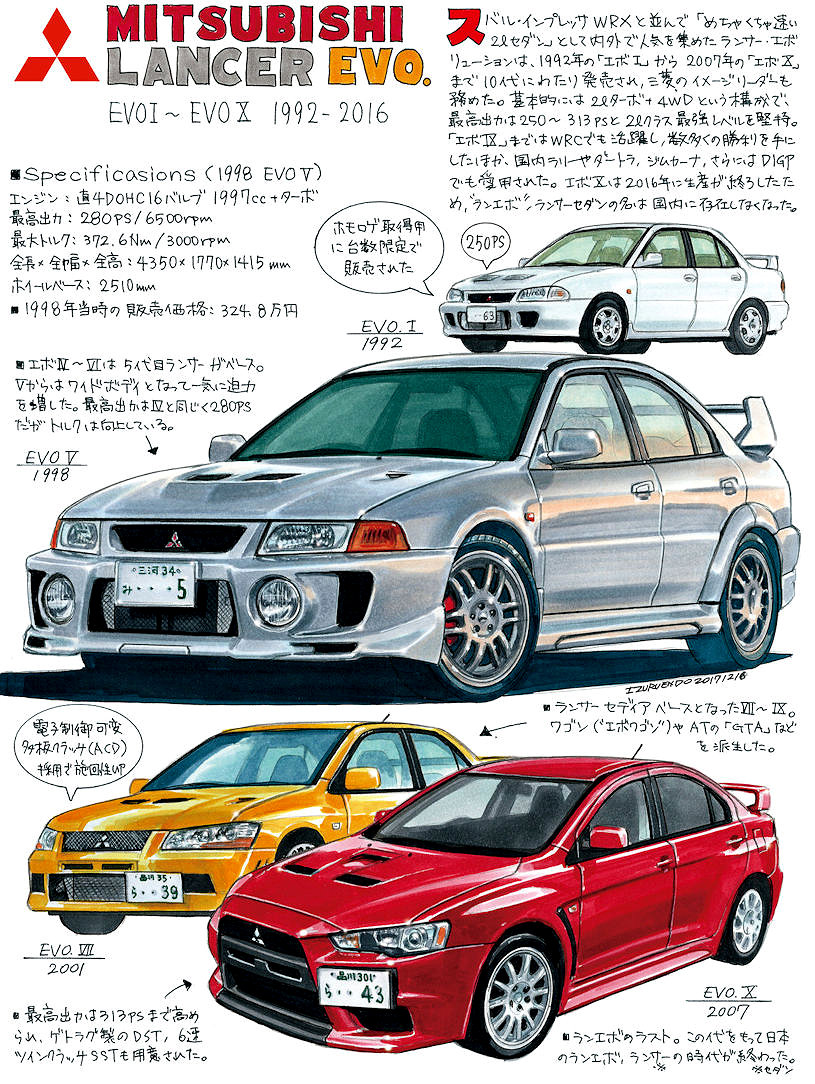
“MITSUBISHI LANCER EVOLUTION”
Alongside the Subaru Impreza WRX, the Lancer Evolution gained popularity both domestically and internationally as an “incredibly fast 2-liter sedan.” It was sold over ten generations, from the 1992 “Evo I” to the 2007 “Evo X,” serving as Mitsubishi’s flagship model. Fundamentally built around a 2L turbocharged engine paired with 4WD, it consistently delivered peak power ranging from 250 to 330 PS, maintaining the strongest performance level in the 2L class. Up to the Evo IX, it excelled in the World Rally Championship (WRC), securing numerous victories. It was also widely used in domestic rallies, dirt racing, gymkhanas, and even the D1GP. Production of the “Evo X” ended in 2016, meaning the names “Lancer Evolution” and “Lancer sedan” no longer exist in Japan.
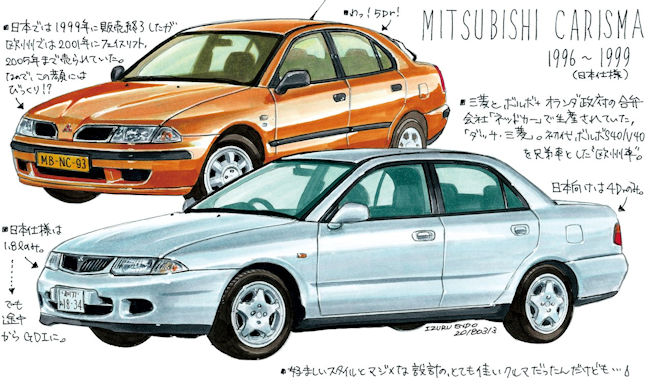
“MITSUBISHI CARISMA”
The Carisma was produced at a factory in the Netherlands jointly funded by Mitsubishi, Volvo, and the Dutch government. Positioned between the Galant and Lancer, 385,308 units were produced over 8 years. This illustration depicts the 1999 facelift model, the first output from Mitsubishi’s design studio in Germany. Volvo used the same platform to produce the S40 and V40. Both the Carisma sedan and the Volvo S40 were exported to Japan, but the S40 was priced about 1 million yen higher. While there were differences in equipment and other features, this clearly demonstrated the difference in brand power.