Pajero’s rival Pajero
Taketoshi Abe
―― Market Changes
In the 1980s, the family car market, which had been dominated by sedans, changed due to the diversification of lifestyles. Users’ choices were no longer limited to sedans, but increasingly sought off-road vehicles, station wagons, and vans to enjoy more versatile leisure activities.
Against the backdrop of such market needs, the 1st-gen Pajero was introduced in 1982 as a full-fledged 4WD vehicle with an RV-like character that also emphasized on-road performance, and was followed by a 4-door long body, AT model, leather interior, etc. The Pajero’s popularity was also solidified by its spectacular performance in the Paris-Dakar Rally.
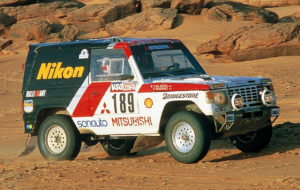
1985 Paris-Dakar Rally winner
Around 1986, when the 1st gen model was still selling well after four years against the backdrop of the RV boom in Japan, which is no exaggeration to say that the Pajero created. While the competitors such as the Nissan Safari, Toyota Hilux Surf, Toyota Landcruiser wagon and Isuzu Big Horn were strengthening their product appeal, analysis of market needs showed that further evolution was needed, such as higher speed performance and improved comfort as a 4WD vehicle, and it was necessary to revise the basic layout to surpass the 1st gen model and build on its success.
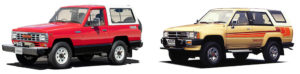
Nissan Safari Toyota Hilux Surf
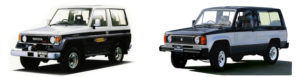
Toyota Land Cruiser Wagon Isuzu Bighorn
―― Direction
It was considered that the second generation would be an all-rounder RV that would combine comfort in urban areas with mobility in outdoor and off-road driving at a higher level. The basic layout was to lengthen the wheelbase and widen the tread, while lowering the overall height by 50mm, aiming to improve ride comfort and high-speed stability with sleeker low-and-wide proportions. The eye point, however, was only lowered 30 mm to ensure visibility. This was done because of Kenjiro Shinozuka’s opinion that “visibility is vital in rally driving.
―― Exploring concept
Initially, only two of us, myself and Ken Yamamoto, aka Ken-chan, were in charge of the exterior design. I think this was partly because at the time, there was still a strong perception within the company that the mainstay models were sedans, and there was little interest in 4WD vehicles at the top management.
Our boss, Chief Designer Oshima, left us to proceed in a laissez-faire manner. We set up a Pajero corner in the studio, displayed outdoor goods, and placed a panel where fellow outdoor enthusiasts could write their opinions. We also tried to absorb as many ideas as possible by involving the designers around us in discussions. As a result, we arrived at a wonderful design concept, “The ultimate all-mighty 4WD.” We have further broken down this basic concept into the three keywords “Toughness,” “Fusion,” and “Easy,” and decided to explore a wide range of possibilities for the moment.
Toughness :
”Hard, wild, and authentic people who are serious about off-road driving”
Fusion :
”Intelligent people who enjoy fusion with nature. The hunting world of medieval European aristocrats”
Easy :
”People enjoy leisure by bringing music and games outdoors. Young people playing on a California beach”
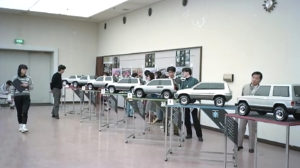
Based on these 3 image keywords, various sketches were developed, each of which was narrowed down to a single proposal, and the work moved on to making 3 quarter-scale models. I worked on the proposal Toughness, while Ken-chan worked on the proposal Fusion and Easy (primary models). At this point, I tore my Achilles tendon playing tennis and was hospitalized for a month, but Ken-chan was able to proceed with the work without delay based on our discussions at the hospital. Then I realized he was a dependable buddy.
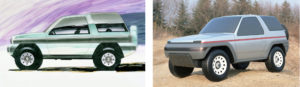
Proposal “Toughness” by Taketoshi Abe
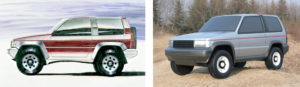
Proposal “Fusion” by Ken Yamamoto

Proposal “Easy” by Ken Yamamoto
After the model was completed, a survey was conducted with all parties concerned, but none of the proposals could surpass the 1st generation in the overall evaluation. We were shocked as we had a certain amount of confidence in our design, and we keenly felt that there was a strong public perception that the 1st generation still had sufficient product appeal. “Pajero’s rival Pajero.”
―― Further 1/4 models, and 1/1 models
This did not allow us to move on to the next 1/1 model, and we had to work on the 1/4 model again. Although “Toughness” and “Fusion” were not as good as the first generation, we judged them to have potential as the first step in giving shape to the image, and we decided to refine them further. On the other hand, we dropped “Easy,” which had received the lowest evaluation, and instead decided to make a new proposal that was a mix of “Toughness” and “Fusion”. For this proposal, we asked Masashi Iwata to come up with a fresh idea.
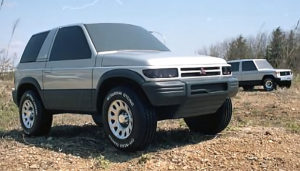
Secondary “Toughness” model
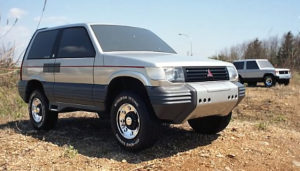
Secondary “Fusion” model
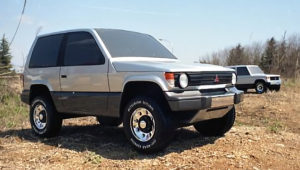
Toughness / Fusion mixed model
Up to this point, the emphasis had been on pursuing the image, but with the survey results, the next step was to enhance the product’s appeal. I decided to refine the “Toughness” by expressing the strength of the 4WD, while Ken-chan decided to incorporate a design around the front of the car that would give the impression of evolution from the 1st generation in the “Fusion”.
After the models were made, a survey was conducted, including the initial models, and both “Toughness” and “Fusion” of the secondary models were rated favorably, and the overall rating exceeded that of the 1st-gen Pajero, which convinced us that we had taken a step forward. What gave us even more confidence was that when we were removing the survey, we found a small piece of paper in front of the “Toughness” model. Scribbled on it was “This model is preferred” and signed “Nakamura. It was a reassuring message from Hirokazu Nakamura, General Manager of the Development Division.
The department then decided to move to the 1/1 model stage, and we were able to gain the support of two new designers. 1/1 models were designed to carry on the design image of the 1st generation, while working on the detailed design of both proposals.
―― Proposal from Cypress Studio
The next stage of the competition consisted of 3 proposals, 2from Okazaki Studio and 1 from Cypress Studio in the U.S., which was also in progress at the same time. The person in charge was Jeff Teague.
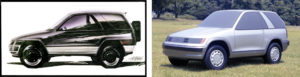
Cypress proposal by Jeff Teague
Soon after, the model arrived from the U.S., and we were amazed. It had a high quality and appearance different from conventional RVs, and we were impressed by the American design of the next Pajero.
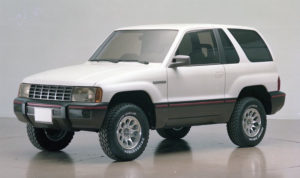
1/1 Cypress model
―― Narrowing down
Meanwhile, our models were also completed, and as a result of an internal survey, all three proposals received a high level of evaluation. The top management review meeting also gave the same high marks, and at this point, “Toughness” and “Fusion” were ordered to put together and to make further refinements together with the Cypress proposal.
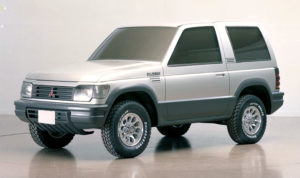
1/1 “Toughness” model
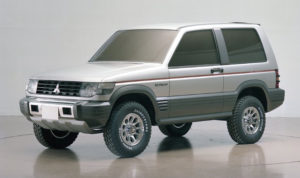
1/1 “Fusion” model
In the final stage, the our proposal was highly evaluated for its evolution from the 1st generation and the Cypress proposal for its direction as a new RV, and our proposal was selected at the design review meeting with emphasis on the design as an evolution of the Pajero. A variety of directions were studied until this point, but the rival to the Pajero (2nd gen) was still the Pajero (1st gen).

Selected Okazaki proposal model

Cypress Proposal model
―― Design finishing
In the subsequent stage towards production, the nose and windshield were slightly set back and tuned to reduce the boxy image. In addition, various aerodynamic improvements were made, such as the use of an inner drip on the short version to create a flush surface, to make the design more suitable for high-speed driving. Although I was initially concerned about lowering the overall height, I was later convinced that a lower center of gravity was in line with the trend, as rollover accidents involving cars with a high center of gravity were becoming a concern in the United States.
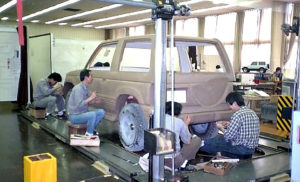
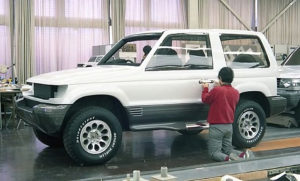
The headlamps of the long version took a step forward from the 1st generation with flush rectangular lamps, but I definitely did not want to make it an ordinary design. At the time, a prototype of the Paris-Dakar Rally had round Heller lamps with a diameter of 220 mm, which were placed behind the nose, and it was cool. So, I designed a rectangular lamp with a large-diameter round reflector. On the other hand, the short model was planned to be equipped with standardized round headlamps, which were widely available in developing countries, but I managed to fit them in the same front aperture as the rectangular lamps that were initially designed.
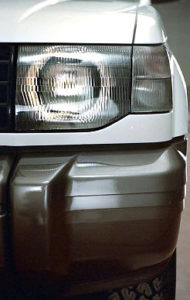
One of the features of the 2nd generation is the side garnish that protects the body from pebbles, and in the high-end version, the garnish and over fenders are integrated into a two-tone finish on the body, including the bumper.This unprecedented treatment has since been followed by other companies’ RVs, and we regret that we did not apply for the utility model.
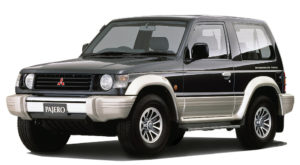
Overfender-equipped version
Around this time, we suddenly received a request to design a prototype for the Paris-Dakar Rally, and for a time Ken-chan and I worked on both jobs in parallel, keeping us extremely busy. However, we were able to get through this difficult time by being quick to take a hint.
There is a popular jinx that says, “The next design that follows the image of a successful car has never been successful”. While working on this design, I was often asked with a straight face by those around me, “Will the 2nd generation be OK? We, the designers and others involved, felt pressure not to fail with the 2nd generation because the 1st generation had been a success, and we were even distressed. So we traveled around the world with photos of the model, carefully verifying the design evaluation, and finally gained a little confidence.
―― Finally
In January 1991, after five years of development, long before one is ready, the 2nd gen Pajero was launched to great acclaim around the world, recording lifetime sales (1.15 million units in 8 years and 7 months) that far surpassed those of the 1st generation. In Japan, the Pajero became the centerpiece of an RV boom that, in retrospect, could be described as extraordinary, and it even surpassed passenger cars to become the No. 1 selling new car of the month in the Japanese domestic market, an unprecedented achievement.
The 2nd-gen Pajero has become synonymous with Mitsubishi Motors, and we were very happy to have played a role in its development. Although we initially explored various directions in design development, I believe that our success was achieved not by simply following the image of the 1st generation, but by evolving the design based on its strengths and weaknesses. Above all, the days of hard work with my teammates and buddy Ken-chan became wonderful memories.
July 2025
Evolved off-road vehicle interior
Masashi Iwata
―― Unprecedented market survey
By the fall of 1986, when development of the 2nd-gen Pajero began, the 1st gen had already been on sale for four years but was selling strongly with no sign of slowing. Consequently, thorough market research was prioritized first. Based on its analysis, the 2nd-gen concept was carefully developed. To grasp user needs, market potential, and technological trends, unprecedented domestic and international market research and test drive events were conducted. We designers also actively participated in these activities alongside colleagues from other departments. Because of this, designers working on other models, who spent their days holed up in the studio, immersed in their tasks, teased us, saying, “You guys seem to be having a lot of fun doing something different.”
―― Survey Findings and Basic Concept
Overseas surveys were conducted across Europe, the Middle East, North America, Southeast Asia, and other regions. I visited Norway, Switzerland, and Germany, where I test-drove reference vehicles to experience driving conditions firsthand. I also observed actual off-road vehicle usage, gathered opinions from journalists, and conducted dealer surveys.
In Europe, the 1st-gen Pajero earned high praise for its performance—comparable to vehicles like the Geländewagen and Range Rover—its well-integrated, functional design, and its reasonable pricing. Particularly memorable was the popularity of the short model as a “second car” among affluent consumers.
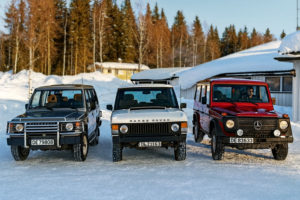
Test drive near Oslo, Norway
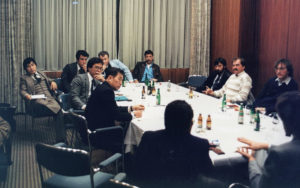
Interview with Journalists in Stuttgart, Germany
In Japan, we interviewed off-road vehicle enthusiasts across the country about their usage and the enjoyment of customizing their vehicles. When gathering feedback from Pajero users, we heard various opinions focused on performance and usability. However, regarding design, there was almost no discussion. When we specifically asked for their thoughts, the response was surprisingly underwhelming for designers: “Design? I don’t have any particular complaints, and I’d rather they didn’t change it too drastically for the next model.” This made us feel the original design was highly valued. At the same time, we recognized that users naturally feel positive about their own vehicle’s design, and it was up to us to consider how to approach future designs. On the other hand, we received numerous comments from users switching from passenger cars and those considering a purchase, expressing a desire for a high-quality feel even in an off-road vehicle. Amid the booming RV (Recreational Vehicle) trend at the time, competitors were also enhancing their high-quality features, and we truly felt we had to aim even higher with the 2nd gen.
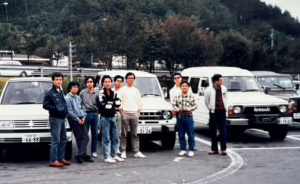
Test Drive at Norikura Highlands, Japan
Based on extensive research both domestically and internationally, the overall concept for the second generation included: – Enhancing perceived quality through a complete redesign of the interior and exterior – Advancing 4WD technology for various driving conditions – Improving safety and comfort for both off-road and highway driving – Further expanding the body variant lineup This approach enabled the model to meticulously address the diverse needs of markets worldwide.
―― Design concept
Under Chief Designer Oshima, who oversaw the design of the 2nd-gen Pajero, our interior team established the basic design concept as “a fusion of premium quality comparable to passenger cars and the functionality expected of an RV.” The 1st gen had low initial production targets, so investments in production machinery were kept to a minimum. For example, the instrument panel core used PVC steel plate instead of plastic, door trim used flat boards instead of molded parts, small components like the steering wheel were carried over from existing models, and bumpers used bending processes instead of press forming – all to drastically minimize investment. However, sales far exceeded projections. While adding higher-grade models through facelifts boosted sales further, the basic utilitarian nature of the vehicle meant there was a limit to how much could be improved. Executives therefore decided that, given the rapidly expanding RV market, the second generation should be developed with the investment necessary to achieve quality on par with high grade passenger cars.
―― From sketch to model
The sketching phase was finally about to begin, but at this point, I was in charge of the team. I couldn’t step away from the CMF (Color, Material, Finish) development for the minor changes to the Delica and first-generation Pajero that I was responsible for. I had no choice but to entrust the sketching to the four team members.

Sketch review meeting
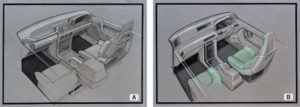
From the various sketches drawn by members, two proposals were selected at a review meeting within the design department. Clay models were then created to evaluate the overall concept. Proposal A, by Hiroyoshi Kawano, aimed to dispel the utilitarian image often associated with off-road vehicles, offering a functional yet smart and three-dimensional design. Proposal B, by Shoji Wada from a partner design firm assisting the project, retained the functional, linear-based image of the 1st gen. After comparing both models internally, Proposal A received higher praise. However, Proposal B, inheriting the 1st gen’s image, was also hard to abandon. Consequently, both proposals were further refined.
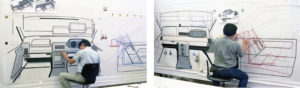
Hiroyoshi Kawano(left)Shoji Wada(right)
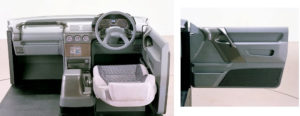
Initial model A

Initial model B
The next stage involved fabricating detailed wooden models. Proposal A initially incorporated the inclinometer—highly acclaimed in the 1st gen—into the meter cluster for a clean look, but this was repositioned as a triple gauge cluster at the center of the instrument panel, mirroring the original layout. Furthermore, meticulous attention was paid to the gauges, assist grips, and control knobs, enhancing the off-road character and premium feel. Meanwhile, Proposal B refined the treatment of the satellite switches on both sides of the distinctive meter hood while also polishing its premium feel even further.
After the management team examined both proposals, Proposal A was selected. Personally, I was convinced that Kawano’s proposal effectively embodied the initial concept of “combining the refined quality of passenger cars with the functionality of RVs,” representing a step forward from the 1st gen design.
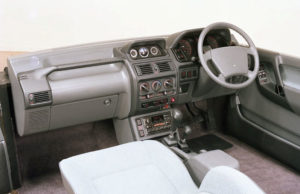
Secondary model A
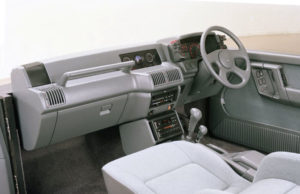
Secondary model B
Subsequently, while preparing this proposal for the next approval stage, I worked hard coordinating with related departments such as planning, engineering, and testing. The testing department, which evaluates interior practicality, repeatedly rejected aspects like the visibility and operability of gauges and switches. They especially saw through our design-first approach to the layout of the hazard switch and power window switches. Balancing aesthetics and practicality was a challenge. We pushed the limits within the tight schedule, but I believe this resulted in a higher-level solution.
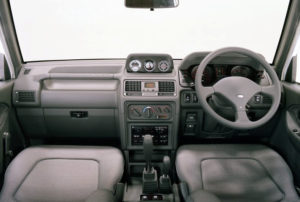
Approved interior model
―― Design of Seats and Convenience Items
I’d like to touch on the seat design I was responsible for here. First, we tailored the design to suit the character of each model: the short and long versions. For the short, we aimed for a sporty design with minimal stitching lines. Initially, I planned to use molded seats, but cost forced me to abandon that idea. Instead, I chose a highly stretchable knit fabric to get closer to the initial goal. Additionally, for the Short J-Top model, I selected water-repellent fabric to emphasize functionality. For the Long, the standard model featured different fabrics for the center and side sections. The premium Exceed model used genuine leather seats with gathers applied to the center section, adding an extra touch to create a sense of luxury.
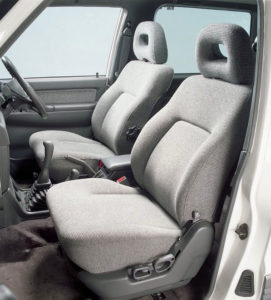
Seat for short version
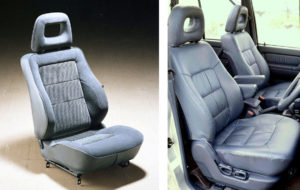
Standard seat for long version (left), Exceed model seat (right)
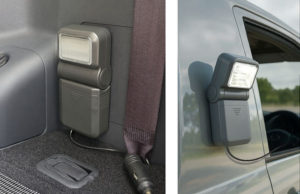
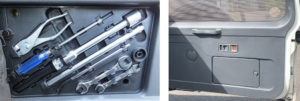
I also designed an inspection lamp and toolbox as convenient items that appeal to off-road vehicle users. The inspection lamp assists with nighttime work and can be attached magnetically to any desired location on the body. The toolbox neatly stores tools on the back door, eliminating the hassle of retrieving gear when needed. These ideas emerged from exploring various concepts inspired by the popular magazine “MONO Magazine” at the time. While it was disappointing that the product didn’t garner as much attention as the triple gauge cluster of the 1st gen upon release, I recall enjoying the design process immensely.
Additionally, I led the development of CMF elements—body color, interior color, and seat fabric—to enhance the vehicle’s appearance and perceived quality. My focus was on achieving the evolution for the 2nd gen through visual and tactile experiences, which was another task that delivered a strong sense of accomplishment.
―― Golden age of Japanese cars and domestic RV boom
The 2nd-gen Pajero was planned during Japan’s bubble economy era and launched after the bubble burst. Yet it not only carried forward the success of the 1st gen but also rode the momentum of the golden age of Japanese cars and the domestic RV boom, achieving tremendous global success as an off-road vehicle. Later media coverage of its success described the Pajero as “a vehicle that precisely understood what users wanted.” This achievement can be attributed to unprecedented market research and extensive test drives of competing vehicles, which allowed user needs to be effectively translated into its design and engineering.
Once the design approval model was completed and received the approval of management, I was unexpectedly transferred to another new project. I deeply regret not being able to participate in the subsequent finishing work for mass production. However, the experience gained during the development of this 2nd-gen Pajero—particularly the intensive collaboration with related departments on interior design and CMF development—contributed significantly to my skill development and confidence. I believe this experience has been invaluable in the design development of various projects since then.

Image for illustrative purposes
December 2025